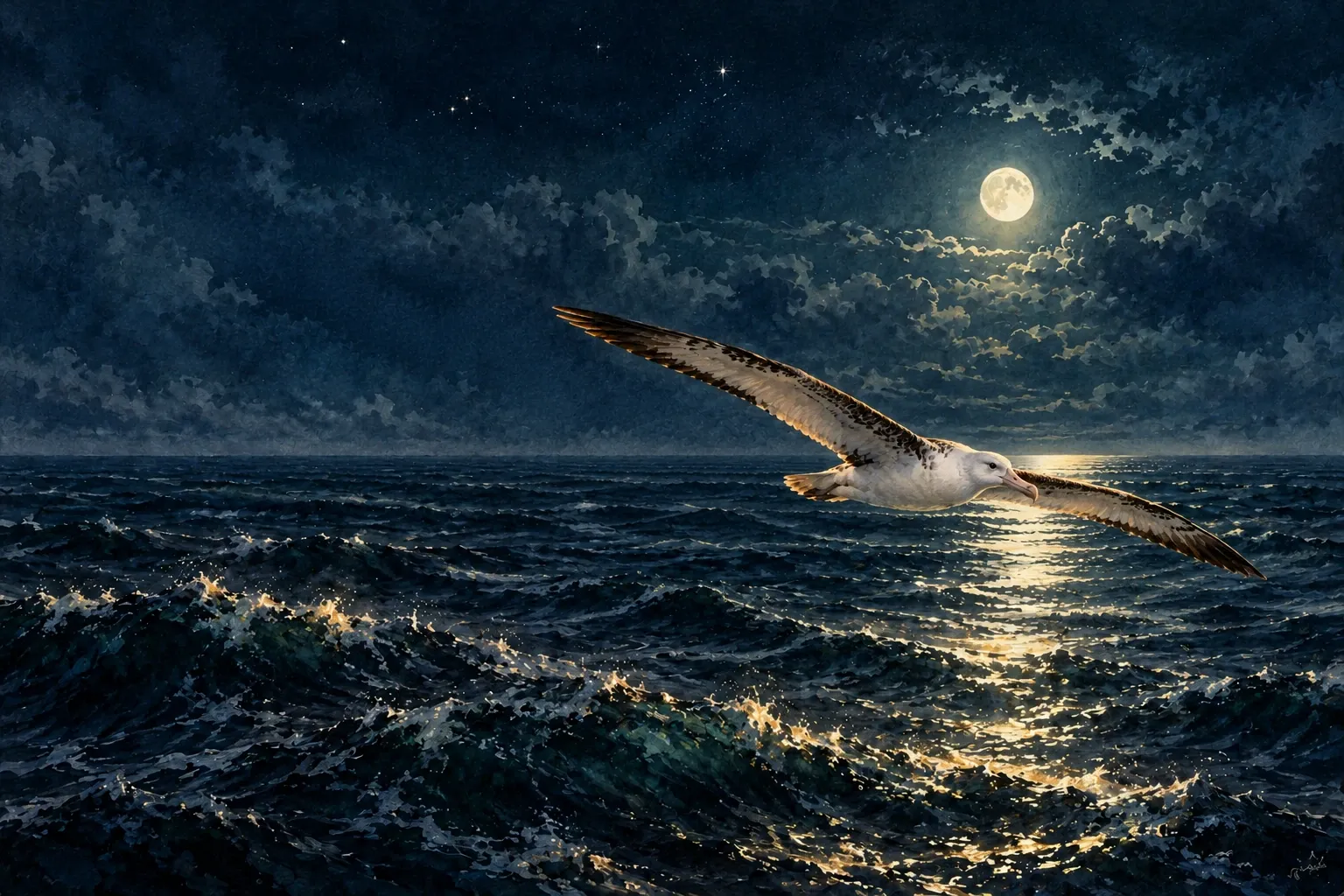
An albatross rides the ocean wind on long, angled sweeps, its wings barely moving as it crosses a reach of water with no shore in sight. It does not force its way through every gust; it finds the lift already moving around it. Its meaning begins there: keep your bearings through a long passage, and let skill carry you farther than strain alone can.
The albatross reads the winds
The albatross is a bird of wide horizons, but its freedom has a direction. It travels far over open water and returns to familiar nesting ground. Wind and sea are not obstacles to overcome one by one; they are the changing conditions it learns to read. As a spiritual guide, the albatross speaks to seasons when plans are hazy and the next clear landmark lies beyond the horizon. It teaches patience in the middle distance: keep moving, observe what is changing, and trust that direction can emerge while you travel.
Yet the living bird tells another part of the story. It rides immense stretches of sea with calm economy, and its presence was welcomed by sailors who saw it as a sign of good fortune. Together, these meanings ask what you are carrying, and whether the old weight still belongs with you.
Long flight, lasting kinship
When the albatross appears as a spirit animal, its message belongs to a changing season: you may be between destinations, restless for a wider view, or unsure which way the current will turn. The bird does not need a straight path across the sea. It works with wind and water, adjusting its flight as conditions shift. Let its story remind you to stay attentive and adaptable through uncertainty; the next useful current may already be forming.
There is a quieter nature beneath that great range. Albatrosses return to breed, perform courtship displays, and raise a single chick. Their long bonds and repeated journeys between sea and home give this bird a lifelong kinship with devotion and return. If it is your totem, its nature holds both distance and attachment: a wide-ranging spirit that still knows the way back to those it loves. Its grace is not in staying still, but in keeping a thread of connection across the miles.
For a demanding task, call on the albatross’s strength for endurance. It can soar for long distances by drawing energy from wind gradients, conserving effort as it goes. Follow that example when a project stretches ahead: notice where your effort can be renewed, take the route that preserves your strength, and keep your attention on the far shore. A long journey becomes possible one well-read current at a time.
The albatross in dreams
An albatross flying high can point toward hopes that are gaining altitude, or a period of widening perspective. If it is just taking flight, the image suggests creative energy beginning to move. A calm bird floating on water brings a quieter sign: the surface has settled, and a difficult passage may be easing. These are dream images of lift and steadiness, not promises of what must happen next.
If the bird circles overhead, the dream may turn your attention to something returning to your thoughts. An albatross far away can make distance itself the message: a goal, bond, or concern may feel remote. A bird that cries out can sharpen the dream’s mood toward mistrust or fear of betrayal; consider what in the scene gave that sound its edge. If the albatross catches a fish and loses it, the image joins success to sudden loss, as if news or an opportunity may arrive with a disappointment attached.
An injured, captured, or dead albatross changes the dream’s open sky into confinement or grief. The image may point to freedom feeling threatened, a plan that has stalled, or a part of your own nature that has been left without room to range. Notice the contrast between the bird’s vast flight and its present helplessness. That contrast is the dream’s heart.
Māori stories of respect
Among Māori communities, albatross feathers and bones were put to use with care: feathers could adorn chiefly garments, and bones could be fashioned into flutes. The bird was valued for food as well, with its fat kept for cooking. In stories, an albatross could be a divine figure and an ancestor connected to chiefly lineage. These traditions place the bird within relationships of respect, ancestry, and practical life, not simply as a distant symbol of freedom.
The albatross’s own life joins these meanings: long passages across the sea, a return to familiar ground, a mate beside it, and a chick waiting at the nest. Keep that image when the way ahead feels wide and uncertain. The bird finds the wind, leans into its lift, and travels on—carrying the knowledge of home within its flight.