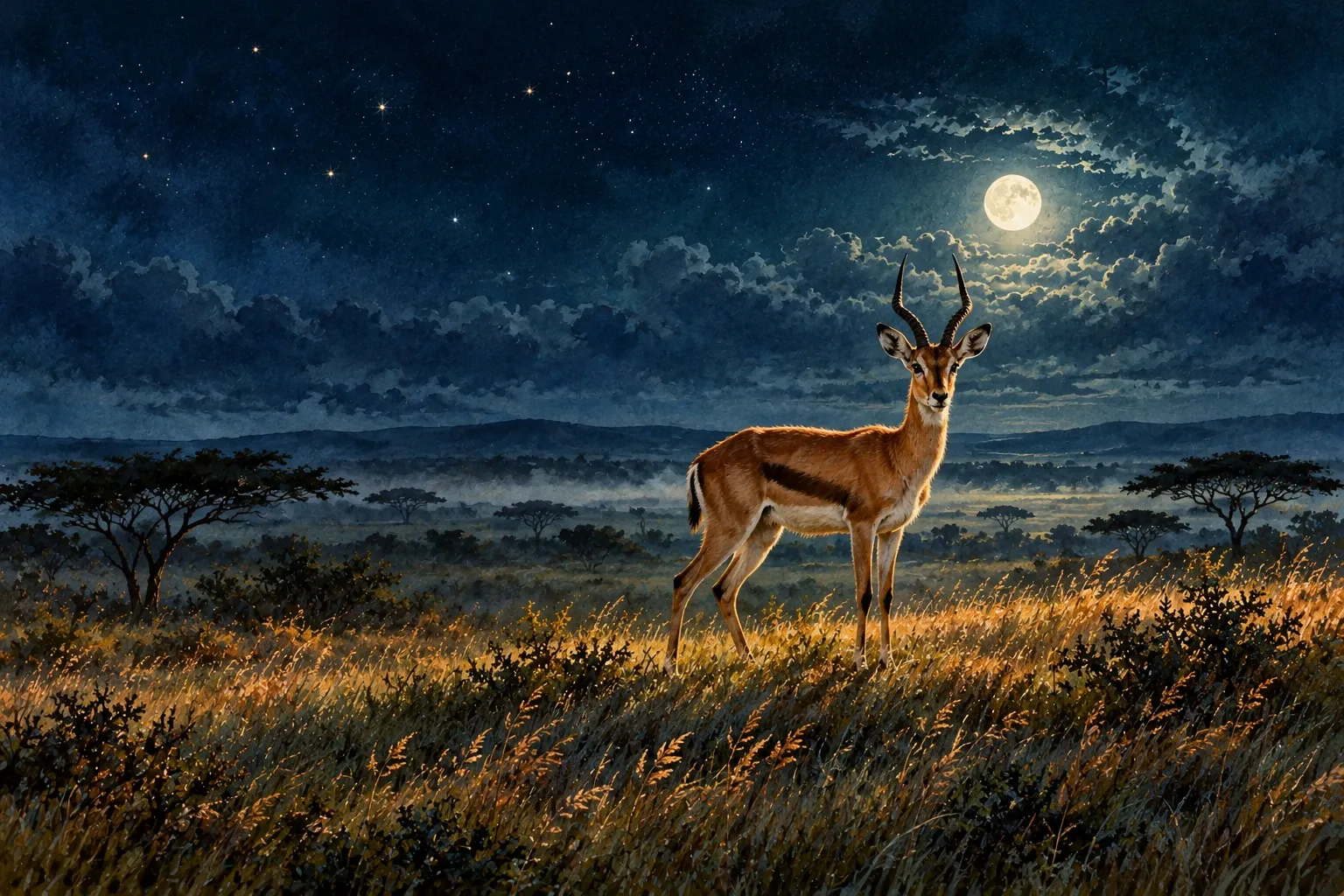
An antelope lifts its head from the grass. Its ears turn; eyes set at the sides of its head take in the open ground, and the herd is ready to move before danger draws near. One antelope’s raised white rump patch can carry the alarm across the plain. Then comes the sudden spring and the clean line of a body crossing open country. Antelope carries a lesson in alertness: see what is happening, trust what your senses tell you, and act while the way is open.
Its swiftness is not only speed. Antelope lives by reading a changing landscape, cropping grasses and shrubs and finding safe passage in the country it inhabits. Some kinds follow the rains toward tender grass. That is a kind of intelligence too: a mind that adjusts quickly and a body that knows when to leap.
Antelope teaches you to read the moment
Antelope’s wide, watchful gaze makes it a guide for times when you feel unsure of your footing. Look again at the whole scene. Notice what has shifted, what lies at the edge of your attention, and what your first clear instinct has already told you. Antelope does not linger over every blade of grass; it watches the open ground for the change that matters.
When a new opportunity appears, Antelope’s story is one of decisive movement. It runs across open country, where a flash of danger can send the herd racing and hesitation can leave an animal exposed. Let that image steady you when a choice is ready to be made. Gather what you need to know, speak plainly, and take the next step with purpose.
There is finesse in this quickness. Antelope survives by responding to the world around it, finding grasses where the rain has passed and taking shelter in the terrain its kind knows. Its example suits a hard season when plans have changed: keep your senses open, find the route that remains, and move with the strength you have.
Keep your instincts close
Some people seem to live with their attention tuned to every small change in a room. Antelope’s keen senses give that nature a fitting image: its eyes scan a wide stretch of ground, its ears catch a sound, and its nose can pick up what sight misses. If this is your lifelong kinship with the animal, its steady counsel is to value your sensitivity and give it room to breathe. Like an antelope that pauses to scan the plain before feeding again, you need times of shelter as well as times to step forward.
When a task calls for courage or clear speech, call on the antelope’s sudden, sure movement. Its body turns alertness into action; a signal from one animal can set the herd moving in a blink. Let that strength sharpen your attention in a difficult conversation or help you begin the work you have been putting off. And like the animal that stays aware of its surroundings, keep your own boundaries in view as you move.
Antelope also lives among others. A sudden signal can put the herd on alert; attention is shared and useful. When you have been alone too long, let the animal’s social life remind you to seek out the company where you feel safe. Quick minds need good companions, too.
When antelope comes in a dream
An antelope running away from you can picture a need to retreat from what is pressing too closely. A little distance may help you see the situation afresh. If the animal lies down, the dream turns on a different image: the watchful creature has gone still. It can suggest that you have let your attention slacken while something important is unfolding.
Notice whether the antelope is alert, fleeing, or at rest. Each image changes the meaning. The dream’s open ground, sudden movement, and pause tell their own story about energy, timing, and what you have seen—or missed.
Stories carried by antelope
In a Bassari creation story, Unumbotte brings humans, an antelope, and a snake into the world and gives them seeds to plant. The antelope says it is hungry and likes grass, so Unumbotte sends it to the grasslands. In this telling, antelope belongs to the living field: it knows what feeds it and finds its place there.
A Kootenai tale sets antelope’s speed against the frog’s clever planning. Proud of its running, antelope accepts a race along a creek. Frogs hidden in the reeds take turns jumping ahead, so antelope runs on, exhausted, until it loses. The tale gives quickness its proper companion: a fast body needs a thoughtful mind.
In Hindu stories, the wind god Vayu rides an antelope. The image joins the animal’s light, swift movement to the wind’s passage across the world. A breeze cannot be held still; it travels where the opening leads.
The pronghorn of North America, often called an antelope, carries this teaching over long distances. As winter sets in, pronghorn migrate southeast from Grand Teton National Park on the second-longest terrestrial migration in North America. Their journey depends on keeping an old route open through a changing landscape.
Antelope leaves you with a small, bright image: a head raised above the grass, ears turned toward the wind, and a sure-footed leap into open country. See clearly. Trust the life in your senses. When the way appears, move.