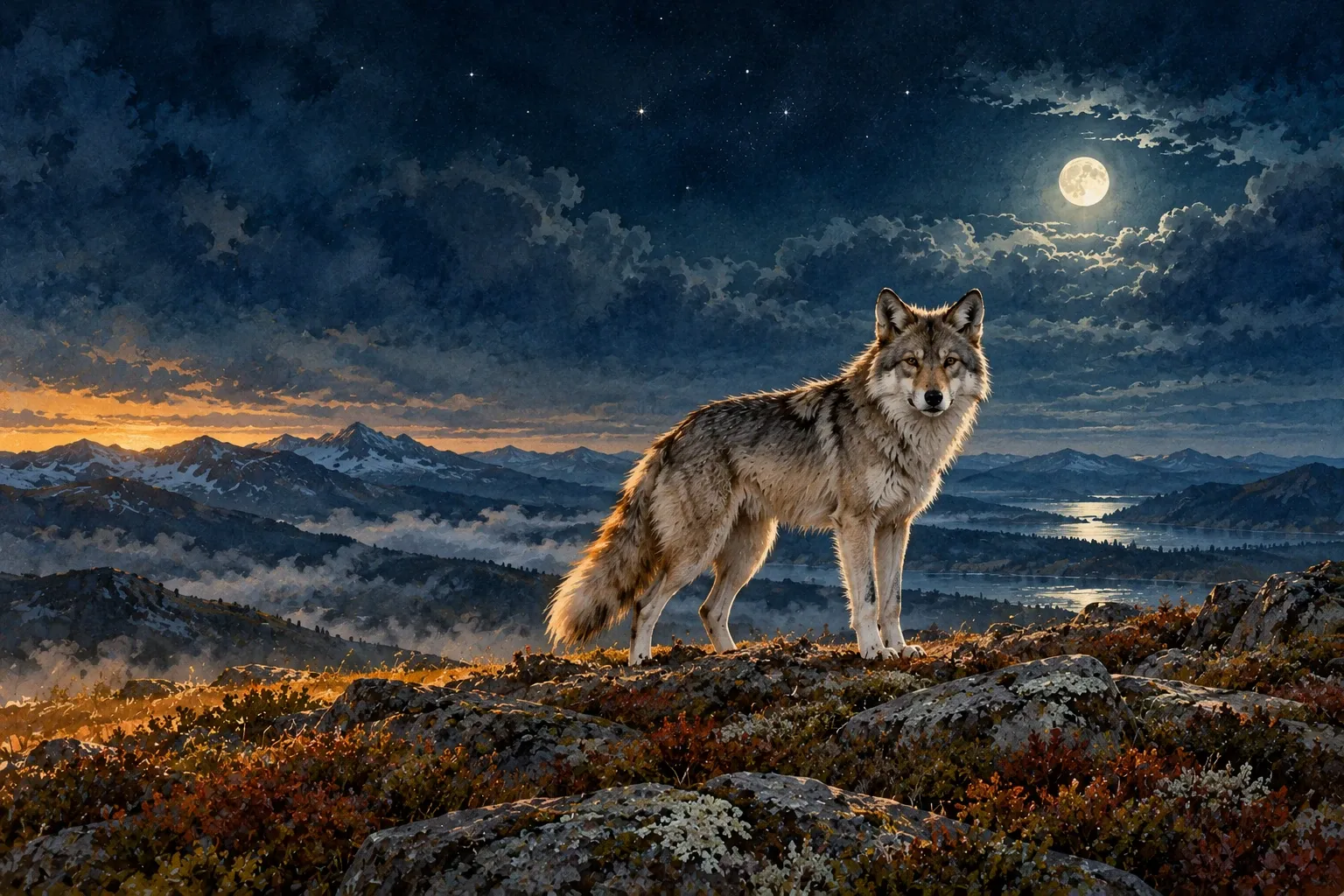
A wolf’s howl can cross a winter valley and bring scattered packmates within earshot of one another. It is a call across distance: a way to find the family, mark a home range, or simply answer the night. Wolf carries that same double knowledge into our lives. Trust what your senses tell you, protect the bonds you cherish, and know when to travel alone and when to answer the call of your people.
Wolf teaches the strength of a steady boundary
Wolves read one another through posture, gaze, scent, and sound. A lifted tail or a low growl can say what a fight would say more painfully. They often avoid needless conflict, yet they can defend their territory when another pack presses in. Wolf’s spiritual meaning begins with that measured strength: know your own ground well enough that you do not have to prove it at every turn.
When you feel misunderstood or unsure of a person’s intentions, Wolf asks you to pay attention. Listen to the words, and notice the expression, the pause, the way someone behaves when there is little to gain. Keep your trust for those who earn it. If a relationship or group has become unbalanced, speak plainly about what you will protect. Wolf’s warning is as clear as its call: vigilance should help you see, not keep you afraid of everything beyond your den.
Wolf also carries the wildness that survives beneath a life of rules and duties. Its keen nose and ears help it find prey and read its surroundings; its endurance carries it over long distances. When you have lost your direction, follow what you know in your bones and take the next step. Instinct is not a promise that every path will be easy. It is a way of paying attention to the life already moving through you.
The pack, the lone trail, and the way home
A wolf pack is a family whose members cooperate to hunt, defend their range, and care for young. Adults bring food to pups, and packmates may help tend them. Wolf’s lifelong kinship is a fierce devotion to the people and work that make a life together. It also holds a quieter truth: closeness does not erase the need for space. A wolf that spends time alone may later join another pack or form one of its own.
If you are in a hard season, let Wolf remind you to use the strengths you have already gathered. Wolves travel far, but they do not have to make every journey alone. Call on a trusted person when the work is too heavy for one set of shoulders. When your circle needs defending, stand firm without turning every disagreement into a battle. The pack’s strength comes from cooperation and attention, not from one voice being loudest all the time.
When you need to make a difficult choice, Wolf lends the hunter’s focus: keep your senses open, choose your moment, and spend your effort where it can matter. Its life in a social group shows another kind of power—knowing how to read a room, communicate clearly, and give leadership as well as take it. And when too much company has made your thoughts hard to hear, walk a little way by yourself. A lone trail can clarify what you want; the howl home can remind you who belongs in the answer.
How a wolf may speak in a dream
A wolf standing watch may reflect a wish to protect your home, children, or close companions as they face a change. If the wolf is calling across a distance, the dream may turn your attention toward someone you have lost touch with, or toward the help you have been hesitant to ask for. Its howl gathers; it does not demand that every traveler follow the same path.
A wolf approaching or chasing you may bring the feeling of being singled out, cornered, or caught in someone else’s scheme. The image can ask you to look carefully at where your trust is placed and to avoid a hurried decision. A wolf that attacks may give shape to a conflict you feel unable to contain. Consider what boundary feels threatened and whether there is a safer way to hold it.
A wounded wolf can put vulnerability beside strength. Perhaps the part of you that protects everyone else has been carrying more than it can bear. A solitary wolf may reflect a period of separation or a need for clearer perspective; it can also suggest that you are missing the support of your own pack. Dream meanings are personal, but the animal’s own pattern offers a place to begin: notice whether it is guarding, calling, fleeing, or trying to return.
The wolf in old stories
In Roman legend, a she-wolf nurses the abandoned twins Romulus and Remus, who grow up to be associated with Rome’s founding. The wolf in this story is at once a fierce animal and a source of shelter: the wild mother who keeps two vulnerable children alive.
The Ainu of Japan have honored the wolf as a sacred spirit connected to the protection of crops and people. In Japan, offerings of rice at small Shinto shrines have been made to Ōkami, the wolf spirit, in hopes that it would hunt animals harming the fields. This is a relationship shaped by land and livelihood, distinct from the Roman tale of the twins.
Christian stories often cast the wolf as danger to the flock, yet the story of Francis of Assisi and the wolf of Gubbio imagines another ending. Francis meets the feared animal and makes terms with it, seeking safety for the townspeople without killing the wolf. The tale leaves room for courage that can negotiate as well as defend.
A wolf’s call carries farther than any one animal can travel. It crosses the dark, finds the scattered, and tells each member where the others are. Keep that sound with you: be keen in your listening, faithful to your own ground, and ready to answer when the pack calls.