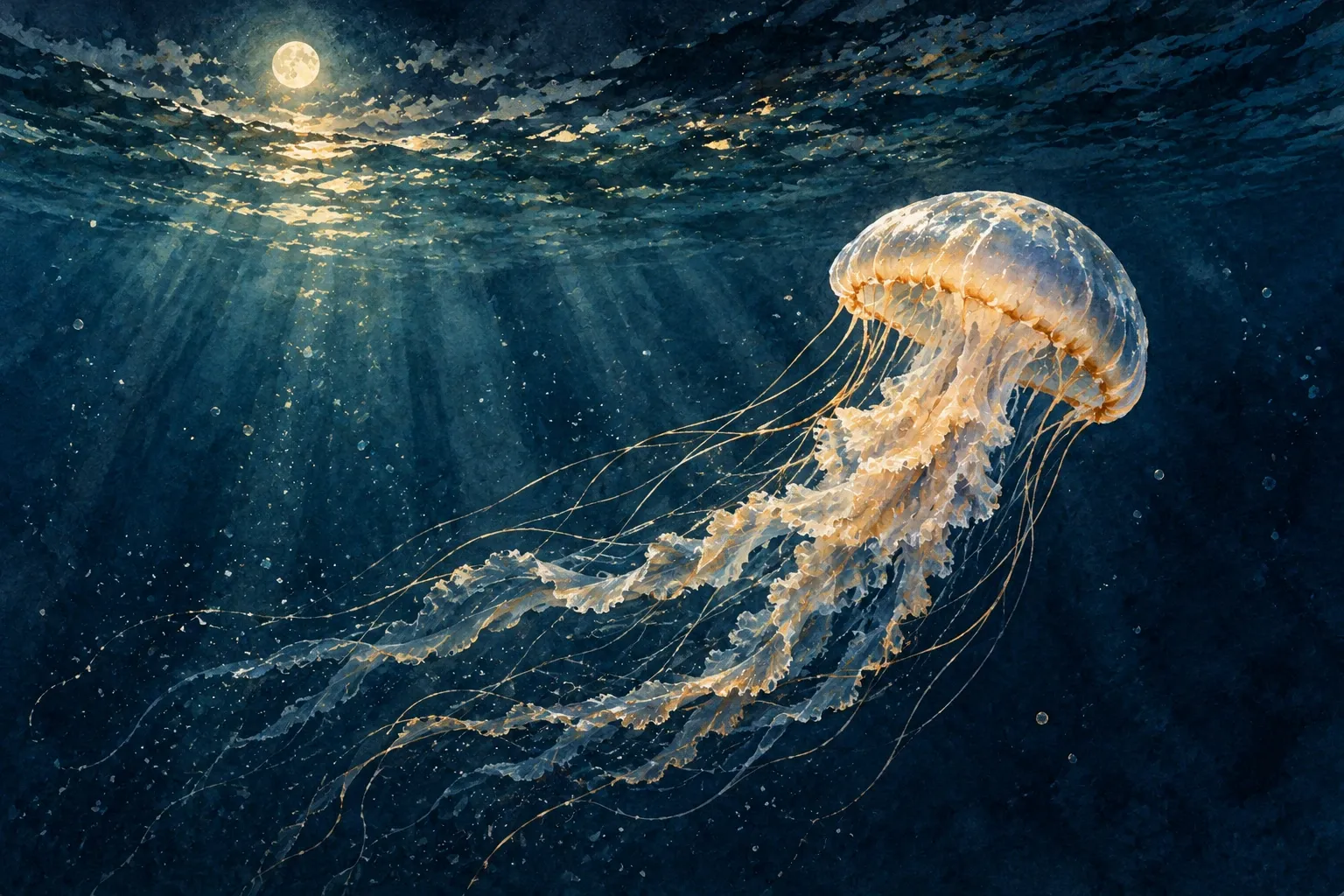
A jellyfish opens and closes its clear bell beneath the water, carried along by currents it cannot command. When it needs to move, it contracts and pushes water behind it; then it loosens and drifts again. Its body seems delicate, yet it has lasted through ages of changing seas. Jellyfish teaches a quiet strength: feel what is happening, move when movement is yours, and let the rest of the current carry you.
The jellyfish has no central brain; its senses are spread through its body, close to the water passing over it. It lives by responding to what touches it. Its spiritual meaning begins with this way of being: sensitivity can guide you when you stay responsive, and a life that bends can still keep its direction. The jellyfish does not need to know the whole ocean to travel through it.
Jellyfish keeps its rhythm in rough water
When a jellyfish spirit animal comes close, your life may feel like a sea stirred by weather. Plans shift, feelings swell, and the way ahead becomes hard to see. The jellyfish does not tense against every wave. It pulses when movement is needed and drifts when the current can carry it. In a season of upheaval, let its rhythm steady you: soften your response, notice what has changed, and make the small movement that belongs to you.
Its way is spare. A jellyfish takes in what sustains it and goes on through a world it cannot command. This animal asks you to look at what you are carrying. Keep what feeds your life; release burdens that have become dead weight. Its faith is not a map of the whole ocean. It is trust enough to keep pulsing through the water you have.
Jellyfish kinship has the feeling of a nature that registers small changes. A room’s mood shifts; a friend grows quiet; a situation turns sharp. The jellyfish’s body meets the water along its whole surface, and its trailing tentacles reach far beyond the bell. Let that wide sensitivity teach you to notice what is near, while remembering that not every current is yours to follow. Keep your openness honest and your limits plain.
When you need strength for a difficult task, jellyfish lends its measured push. Its bell contracts, sending it forward, then opens again. Draw on that rhythm in a stubborn conflict: say the needed truth, then loosen your grip on forcing another person to change. The sea nettle’s sting adds another part of the lesson. Gentleness does not ask you to leave yourself unguarded; a boundary can protect a tender nature without making it hard.
The jellyfish’s yielding is not helplessness. It can travel with currents and still propel itself. It survives by responding to conditions around it, and some kinds move toward warmer waters as seasons change. This is a creature of timing as much as surrender: recognize when the water is carrying you, and when a pulse of your own is needed. You do not have to push every moment to keep going.
Light, difference, and the chance to begin again
Jellyfish come in a striking range of shapes and colors. The lion’s mane trails long tendrils from its bell, while the mauve stinger can glow in the dark. Their many forms carry a teaching about the strength of difference: the ocean holds many ways of being, and each has its own shape and place. Let the jellyfish remind you that a quiet presence can still be vivid.
Some jellyfish make their own light. The atolla jellyfish, when threatened, produces a swirling flash that can draw a larger predator toward the one attacking it, giving the jellyfish a chance to escape. This living brightness carries a teaching about radiance and defense together: what shines from you can travel outward, and your presence deserves care. Let the work, kindness, or art that is truly yours be seen, while staying mindful of what you let close.
One small species, Turritopsis dohrnii, can reverse its life cycle under stress or after damage, changing from its adult medusa form back to an earlier polyp stage. That rare turn gives jellyfish a particular meaning of renewal. Sometimes continuing begins with returning to simpler ground, gathering strength, and beginning again from there. It is not the same as going backward in spirit; it is a living creature finding another way to carry on.
When jellyfish enters a dream
A jellyfish near the water’s surface can suggest that old feelings or memories are rising into awareness. The water has carried them upward; give them attention before they sink again. A jellyfish caught in tall grass points toward something that has you feeling held fast, perhaps a truth you have found difficult to say.
If a jellyfish stings another creature in the dream, the scene may hold anger or a conflict close to breaking open. Its sting is a defense; ask what hurt or boundary lies beneath the sharpness. If it drifts smoothly through the water, the image carries a gentler meaning: a stretch of calm follows rough passage, and rest is near.
A jellyfish struggling in water suggests effort spent fighting conditions beyond your reach. The animal cannot command the ocean, but it can pulse and respond. See what changes when you stop thrashing and look for a current you can use. The dream leaves you with the image of a body still moving, even when the water is difficult.
Ebisu and the sacred jellyfish
In Japanese tradition, the jellyfish belongs among the sacred creatures of Ebisu, a god who protects fishermen and brings them good fortune. Ebisu is sometimes called the Laughing God, and his story holds humor beside the jellyfish’s delicate, uncanny beauty. For people whose lives depend on the sea, this creature sits close to the fortunes and risks of fishing, and to a god whose presence is remembered with a smile.
The jellyfish leaves no grand command. It gives a clear image: a bell opening and closing in the dark, a small pulse that moves it forward, then the generous drift of the current. Keep that rhythm when the water changes. Move when it is time, yield when you can, and let your quiet light travel with you.