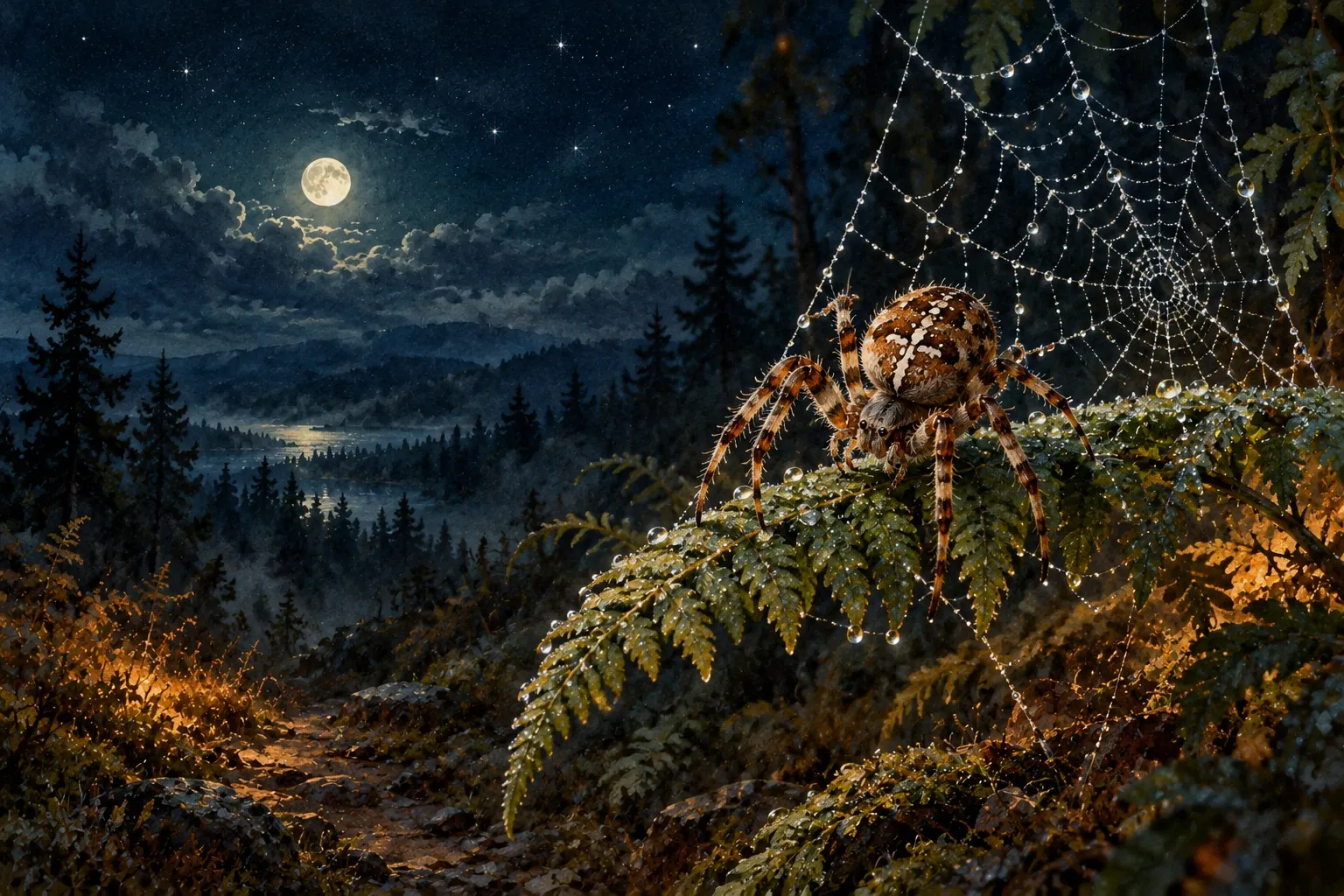
A spider lays one shining strand across the morning air, then another, joining them into a web strong enough to hold what the wind cannot. Each thread comes from her own body; each one belongs to a larger pattern. Spider’s meaning begins there: what you make with patience and care becomes the world you live in, and every strand touches another.
Spider’s patient art
Spider does not hurry the work. She builds, waits, feels the web tremble, and answers what comes. If a strand breaks, she can repair or remake it. Her teaching is to trust the steady work of creation: gather what you have, find the next point of connection, and let a good pattern take shape over time.
The web is a picture of how a life holds together. Family, friendship, work, memory, and desire pull on one another, sometimes gently and sometimes all at once. Spider asks you to look at the pattern before you tug at a single thread. A choice made today reaches into tomorrow. Words can bind people together, or catch them in a snare; use them with care.
Her web also begins in darkness and glimmers when the light finds it. Spider knows both the hidden work and the bright result. She teaches that creativity can start in quiet corners, before anyone else sees what is forming. Her silk is delicate to the touch, yet remarkably strong. In Spider’s hands, gentleness and strength belong to the same craft.
The thread you are weaving
A web-building spider lays silk from her own body, joins each strand to the next, then waits for a tremor to tell her where life has touched it. When a project stalls, follow her example: begin with one sound connection, then give the work time to answer. Her eight legs carry her along narrow threads; they show the balance needed to keep moving between what has been and what is still taking shape. Let Spider steady your footing through a hard season.
Some spiders wait in webs; others hunt freely, moving quickly when the moment comes. Their different ways teach that a useful plan fits its task. When a pattern stops working, change your route: rebuild, wait, or move with precision. For the lasting kinship of a spider, notice the patience of a web-builder, the quickness of a hunter, and the sensitivity that reads each vibration. Call on those strengths when a task needs careful planning, a fresh idea, or one decisive move. How will you shape the next strand?
Spider in the stories of peoples
In Diné and Hopi traditions, Spider Woman or Spider Grandmother is a creator and helper to people. Hopi stories connect Spider Woman with the Earth and tell of her creation of the first man and woman alongside Tawa, the Sun. Cherokee tradition remembers Grandmother Spider bringing light into the world during darkness. These stories carry Spider’s creative power in distinct ways: as world-making, guidance, and the arrival of light.
Lakota stories know Iktome as a trickster, while African stories of Anansi tell of a spider who outwits stronger opponents through wit and strategy. In Ashanti oral tradition, anansesem means spider tales. The trickster does not prevail through size; he reads the situation and finds the thread others have missed.
Greek myth tells of Arachne, a gifted weaver who challenged Athena and was turned into a spider. Her story joins artistry with consequence: skill can speak boldly, and what we create carries our choices. In ancient Egyptian belief, Neith weaves the world and its destinies, renewing the work as each day begins. Across these stories, Spider’s web holds creation, skill, and fate, while each tradition gives those threads its own shape.
When Spider visits a dream
A spider crawling over you can suggest protection around something that feels threatened. A web wrapped around you points to frustration or entanglement, though the dream also leaves room to find a way through. If someone else stands behind a web, the image can suggest jealousy, possessiveness, or a trap; watch how trust is being woven between you.
A spider chasing you can point toward a longing for freedom. If you are frightened of spiders while awake, the chase may instead bring a fear you have been avoiding into view. A spider building its web carries a different feeling: the patient work you are doing can become a source of contentment. If you build the web yourself, the dream speaks of effort gathering into success. An orb web can signal that events are moving quickly; a sheet web may hint at something hidden from view.
When a spider startles you in a dream, take it as a sharp call to notice what is unfolding around you. A distant spider can place the matter further ahead. The larger the spider, the more weight the dream gives its message. Let the image stay particular: a careful builder, a sudden movement, a web catching light. There is the thread worth following.
Spider’s web is made strand by strand from within her own body. She waits, senses the smallest tremor, and repairs what needs mending. Remember that bright web in the morning: fine as a breath, strong enough to hold. Your next act is one more thread, and the pattern is already taking shape.