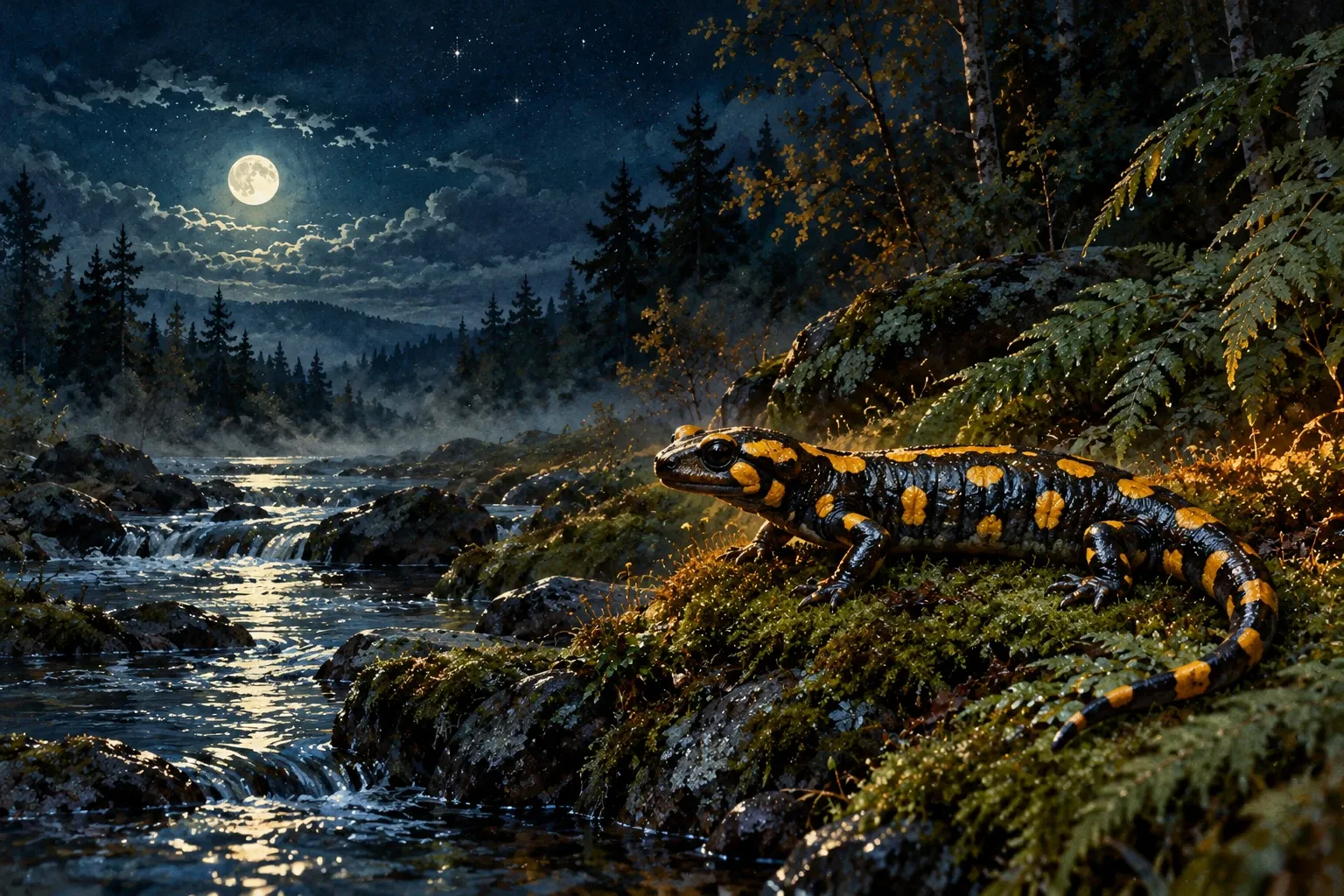
A salamander slips beneath a rain-darkened log, its smooth skin taking in the damp air as the forest cools around it. By day it keeps to shade and shelter; when the ground is wet and night settles in, it ventures out again. This small amphibian belongs to the meeting place of water and land, and its meaning grows from that way of life: stay sensitive to your surroundings, protect what is vulnerable, and begin again when change asks it of you.
Salamander’s quiet work of renewal
A salamander’s skin is more than a covering. Many breathe through it, and substances in their surroundings can pass through that delicate surface and harm them. Water and clean ground are part of what lets them live. Salamander teaches a plain kind of attention: notice what you are taking in, and care for the places and company that shape your days. A life lived close to the world requires both feeling and discernment.
When danger comes, a salamander has ways to survive. Some can drop their tails, leaving the twitching piece behind while they escape. Certain species can regrow a lost tail or limb; the axolotl is especially known for its ability to regenerate body parts. Regrowth does not erase what happened. It shows how much life can do with what remains.
When Salamander comes close during a changing season, let the next shape of your life take form in its own time. Young salamanders often begin in water with gills, then change as they grow toward life on land. Their passage asks for adaptation without panic. You can leave an old way behind, learn the conditions of a new one, and keep your balance as you go.
The gifts of a creature between worlds
A lifelong kinship with Salamander belongs to people who feel the turns in life keenly. The animal is elusive, often resting under logs, stones, or leaves through the day, and it moves through cool, damp places when conditions suit it. Its nature speaks to people who keep some part of themselves private, notice quiet shifts, and feel at home in the hours when the world grows still. Their sensitivity is a form of knowing; it also calls for care about what they let close.
When a season of life asks you to change, Salamander’s message is to adapt without turning the passage into a spectacle. Its young do not leap from egg to full-grown life in a day; they develop through different conditions. The spirit animal’s gift is steady adjustment, especially when the next step is not yet clear. Take help where it appears, cooperate with the people and surroundings that sustain you, and let a subtle transformation unfold.
For a task that needs fresh energy, call on Salamander’s power to renew your attention. When a project has gone stale, look beyond your usual habits for inspiration. When you feel overwhelmed, its close ties to cool water and sheltered ground point toward a steadier footing. Its protection is quiet: a salamander’s bitter secretion can deter a predator, and a dropped tail can buy it time to escape. Let that pattern remind you to guard your boundaries, keep confidence where it belongs, and release what holds you fast when you need to move.
Fire stories and the water’s edge
For centuries, the salamander was said to survive in fire, its cold body putting out the flames. The story may have grown from a striking sight: salamanders hide in damp or rotting wood, and one carried unknowingly into a hearth could emerge among the sparks. When frightened, it can release a pale secretion. To someone watching, the animal seemed to step out of fire protected by a power of its own.
In the Talmud, the salamander is connected with fire, and a portion of the creature was said to protect its bearer from flames. Medieval tales gave salamanders further strange forms and powers. These are old images of an amphibian people rarely saw clearly. The living animal keeps to cool, moist shelter; its real resilience lies in its ability to escape, adapt, and, in some species, regrow what was lost. In Celtic heraldry, the salamander also came to represent protection.
In Chinese tradition, salamanders have been associated with the balance of yin and yang, sometimes pictured as two great salamanders intertwined. The image suits an animal that moves between water and land, rest and motion. In Japan, the giant salamander holds a place in local lore. A legend from Yubara tells of a giant hanzaki whose spirit was honored as a deity after its death, and the town holds the Hanzaki Festival each year on August 8. This is a distinct local tradition, rooted in the creature’s place in that landscape.
What Salamander brings into a dream
A salamander emerging from fire carries the image of surviving a hard passage and finding the strength to reclaim your life. One curled in dirt or leaves points toward the ground that shelters you and the care owed to it. If the salamander suddenly changes direction, the dream may suggest that your present course needs adjustment so that your work and energy can find their balance again. A quick-moving salamander brings urgency: attend to what is ready to move now.
If it loses its tail, the dream centers on escape through release. The animal leaves something behind and gets free; the image may speak to a burden or attachment you are ready to loosen. A sleeping salamander holds a quieter meaning. It can suggest a hidden life gathering strength beneath the surface, or a dream life becoming more vivid and memorable. Let the details of the scene guide you: the shelter, the direction of travel, and whether the animal is safe or threatened.
Salamander’s way is small and sure. After rain, it leaves the shelter of the log and crosses the dark ground with its skin alive to every change in the air. It teaches that sensitivity can protect life, that loss can make room for regrowth, and that balance is found by adapting to the world as it is. Follow the little traveler to the water’s edge, and remember the quiet courage of beginning again.


