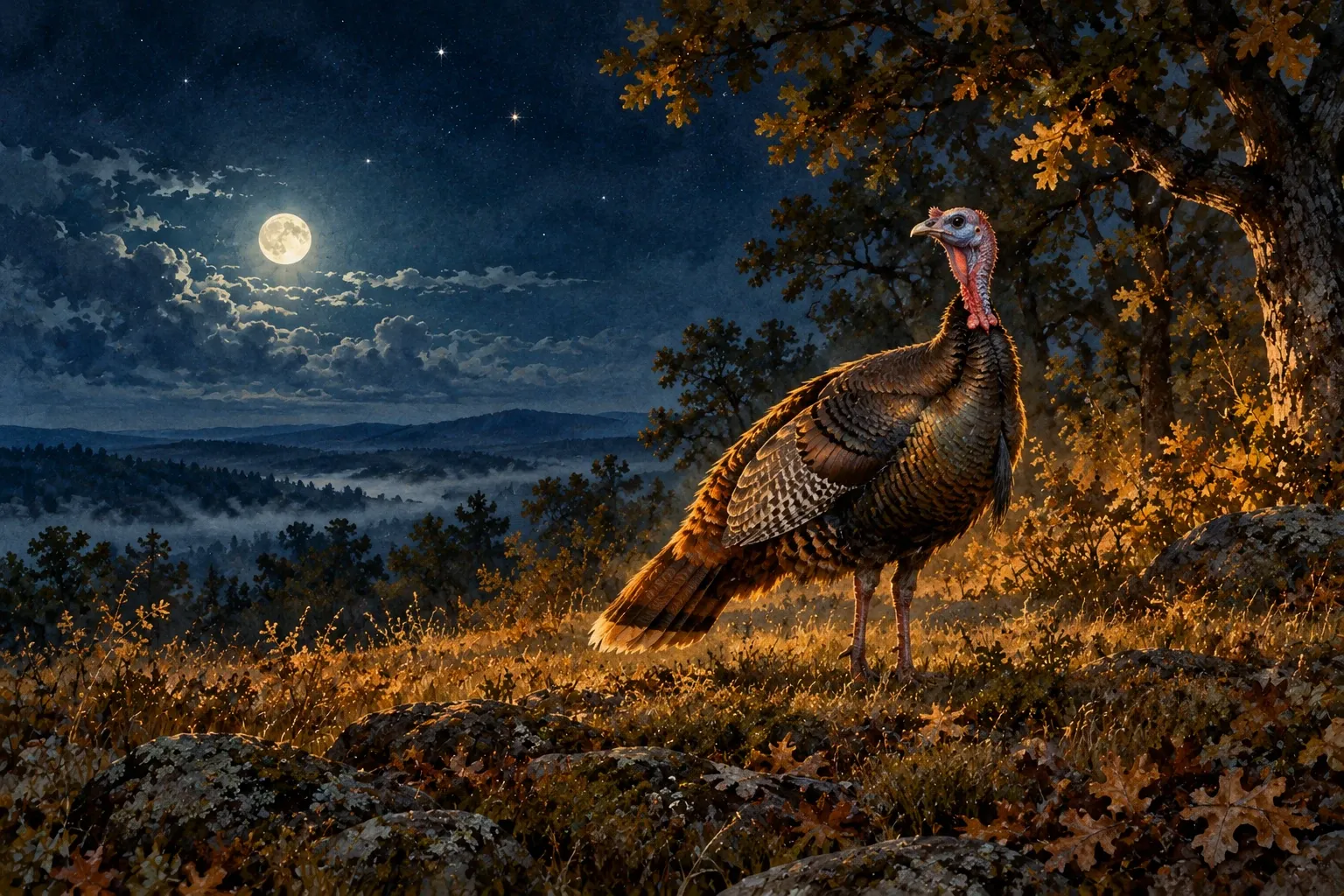
A wild turkey works the leaf litter with quick feet, turning over what the forest has dropped: acorns, seeds, and small living things. Nearby, other turkeys scratch and call. When evening comes, they rise to roost together in the trees. This bird knows how to gather what will nourish it and how to live among its own. Turkey’s teaching is simple and generous: take care of what sustains you, and let its good reach beyond yourself.
Turkey’s harvest is meant to be shared
In autumn, turkeys gather into flocks. They feed across the ground, alert to one another, and settle together for the night. Turkey brings this communal instinct into a season when you have something to give: food, time, attention, or a hand with the work. Its message is to look around your own circle and see what would help someone stand easier.
Turkey also knows the value of what is already at hand. It eats a varied diet, including acorns and seeds, and can adapt to different places. When life feels thin, Turkey points you toward the resources close by: a skill you have practiced, a friend who would welcome your call, or a small beauty that steadies the day. Gratitude begins with seeing these things clearly.
A gift can arrive in an ordinary shape. The flock shares space and keeps watch through the evening; you, too, can receive help without making a grand story of it. Let another person’s kindness feed you, and pass kindness along when your own hands are free.
The flock teaches kinship and courage
Some people feel Turkey’s nature as a steady kinship with family, friends, and the living world. They notice who has been left out, remember what a household needs, and find satisfaction in making enough to share. Like a turkey returning to its flock, this nature is social and attentive. Its care is a gift; its boundary is part of the gift, too. Keep enough strength for your own needs so your generosity can last.
When a difficult task calls for nerve, Turkey lends the courage of a bird that can defend itself and its flock. A tom can fan his tail, puff his feathers, and face what has come close. In danger, a turkey can also run fast and change direction with surprising quickness. Take the quality the moment asks for: stand your ground when someone needs protecting, or move briskly when a new route opens.
Turkey’s full presence can look awkward from a distance, but there is alertness beneath the display. Its message for a doubtful season is to trust the useful abilities you already carry. Put them to work for something larger than your pride, and let the results speak.
Turkey stories of seeds and rain
A Navajo story remembers Turkey carrying seeds into a new world and scattering them so crops could grow. The image joins the bird to the future harvest: what is carried through hardship can become food for many. In a hard season, keep hold of the small things that can begin again—a skill, a promise, a saved seed of an idea—and give them the ground they need.
Among Ancestral Pueblo peoples, turkey feathers were tied to rainmaking, prayers for clouds, and maize agriculture. In the prehistoric Southwest, people used turkey feathers in ritual costumes, prayer sticks, regalia, and feather bundles. These traditions carry their own histories and meanings. Together, they show how closely the bird’s life has touched the practical and sacred work of tending crops, making ceremony, and asking for rain.
What a turkey dream may be saying
The feeling of the dream matters. A flock of turkeys feeding or a turkey given to someone can point toward abundance that grows through sharing. If the bird is caged, the image may speak to a part of your life that feels confined: perhaps a friendship, a family role, or a talent waiting for room to develop.
A turkey that suddenly turns while walking can suggest a change in direction and a choice ahead. One that looks away may bring attention to a matter you have neglected or a decision you have been making without enough care. A dead turkey carries a heavier tone; it may reflect a fear of being mocked, dismissed, or made to feel foolish. Ask where your confidence has taken a knock, then decide what deserves your voice.
A turkey calling or chattering brings conversation to the foreground. There may be words waiting to be spoken plainly, especially between people who share a home, a responsibility, or a piece of work. And if the dream places the bird in snow or bitter cold, its stark setting may bring to mind a habit or situation you are ready to leave behind. These images do not predict what will happen. They give the mind a bird’s-eye view of what is already asking for attention.
The turkey scratches through the fallen leaves, finds what the day has left, and calls to the flock as dusk gathers. Its lesson stays in that small, vivid scene: gather what nourishes you, keep your people close, and let your good fortune feed more than one life.