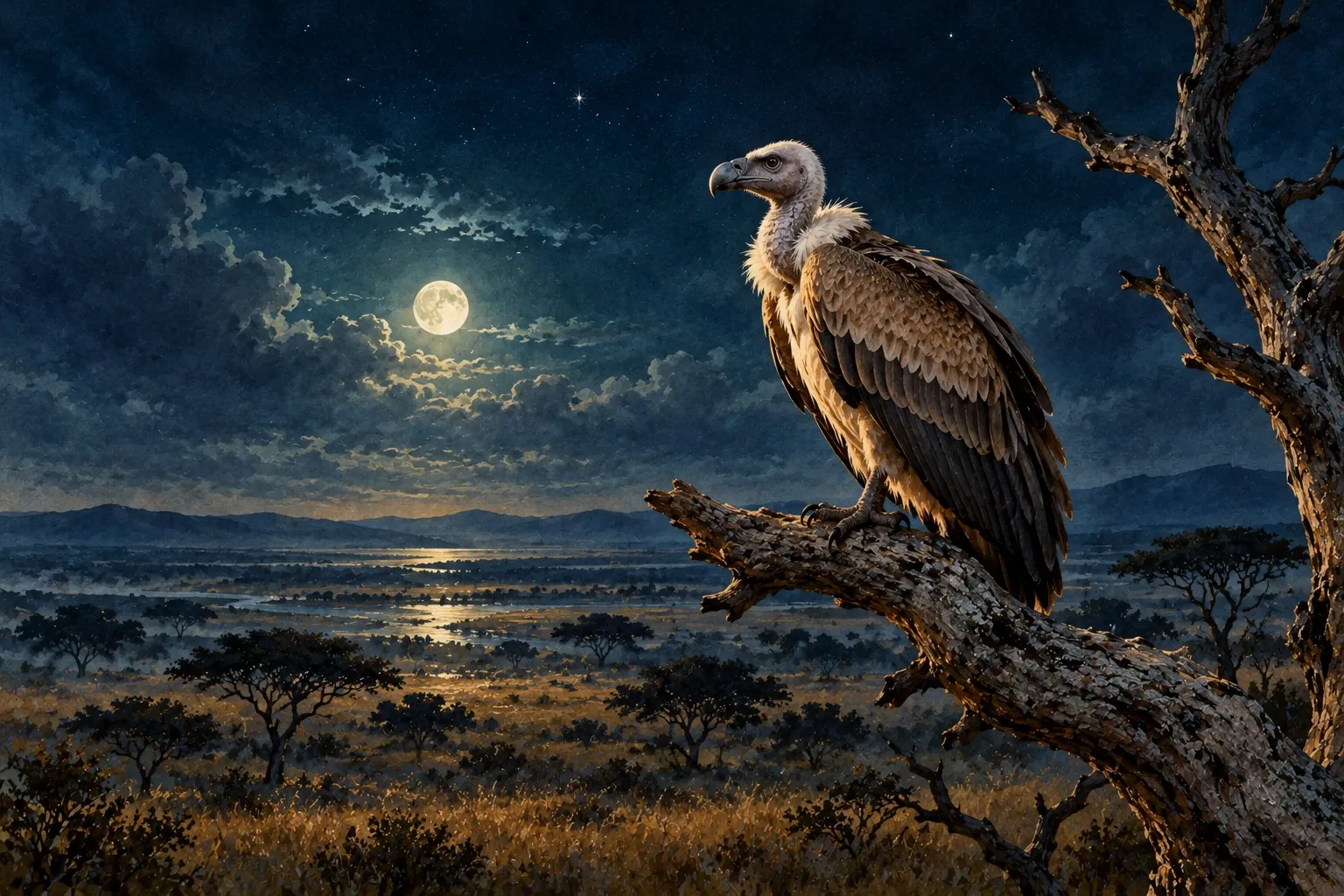
A vulture can circle above a sun-warmed field for a long while without a single wingbeat, held up by air rising from the earth. Below, a fallen animal returns to the living world through the mouths of scavengers. The bird’s work is plain and necessary: it clears what has ended and keeps life moving. Vulture teaches that an ending can become another creature’s beginning.
What the vulture clears
People often notice the bare head and hunched shoulders first. Look longer, and the vulture’s way of living comes into view. It waits, watches, and makes use of the wind. It feeds on what is already dead, and its body can withstand the dangerous bacteria in carrion. What looks grim from a distance is, up close, a kind of care for the whole field: the vulture helps keep decay from spreading unchecked.
That work gives vulture its spiritual meaning: cleansing, death, and renewal belong to one turning. The bird does not make death easy or pretend it is anything but an ending. It shows how the living world carries on through it. A season of grief, a role you have outgrown, or a habit that has run its course can leave something behind. Vulture asks you to look steadily at what is finished and see what might still nourish the life ahead.
The vulture’s work also carries a lesson about the parts of life people would rather turn away from. Its appearance may seem ungainly on the ground, yet the bird rises into a wide, graceful flight. Its place in the cycle is valuable even when it is not admired. When you feel overlooked for the work you do, remember the vulture: the worth of a task does not depend on how handsome it looks to others.
Vulture’s patience and kinship
The vulture reads the thermals and lets them lift its broad wings, gliding for hours with little effort. It does not waste strength flapping against every current. When a hard season asks for patience, follow that example: watch carefully, save your effort, and move when the air begins to rise. Vulture’s spirit comes through when life is changing course and you need to see what is opening above the old landscape.
If vulture feels like lifelong kin, its nature is steady and observant. It can linger in the sky, looking over a wide stretch of land, and still know when to descend. Let that kinship teach you to keep your senses awake and to trust careful attention. The turkey vulture finds food by scent as well as sight; its way of noticing is a reminder to pay heed when something feels out of place. When a particular task calls for resolve, borrow the vulture’s thrift with effort: one strong stroke can carry you farther than restless flapping.
Vulture parents also tend their young with care. A vulnerable chick needs a long stretch of incubation and attention, and its parents keep close while it grows. The bird holds patience and protection together: the clear-eyed scavenger above, the attentive parent at the nest. When you are tending a new idea or someone who depends on you, give the work time to become strong. The vulture’s example is not a quick rescue, but watchful care that lasts as long as the young need it.
At dawn, vultures spread their wings in the sun, warming and drying them. Their morning posture has the look of a greeting, and it serves a practical purpose too. The bird’s life joins what can seem like opposites: the earthbound work of returning remains to the cycle and the airy ease of soaring high. Vulture reminds you that clear sight can stay grounded in the body and in the ordinary work of living.
When a vulture comes in a dream
A vulture circling overhead can give shape to the feeling of being watched, judged, or kept under pressure. Its patient orbit may suggest that a difficult matter is returning to view, or that demands seem to be gathering around you. If the bird circles while you wait for something to happen, the dream’s stillness may echo a season in which you are watching for the right moment to act.
If the vulture attacks, the image can point toward sharp criticism or a struggle with someone who has authority over you. A flock landing near your home may bring the feeling of a threat approaching private life. Capturing a vulture can suggest a conflict with someone close. These images carry tension; the dream may be giving form to pressure or friction already present in waking life.
A vulture flying straight upward brings a different feeling: a long climb, a rise in standing, or a broader view after difficulty. A baby vulture can represent a new idea or project that still needs care. Feathers in your hand may gather hope around future blessings. If you become a vulture in the dream, the image turns attention toward endurance and the possibility of moving through life with fewer obstacles. When the bird simply watches, its stillness can point toward something you have not yet examined closely.
Vulture in sacred stories
In ancient Egypt, people revered Nekhbet as a vulture goddess associated with protection. Her outspread wings made the bird a guardian image, and the vulture’s close care of its young gave that image a connection to maternal protection. The same bird that feeds among the dead could stand for safety and care among the living.
Zoroastrians entrusted the bodies of the dead to vultures in an honored funerary practice. In that setting, the bird’s work belonged to a passage after death: the body returned to the elements, while the soul continued its spiritual journey. The vulture was part of a solemn rite, not merely a sign of loss.
Among Pueblo peoples, the turkey vulture held a role in rituals of purification and grounding after ceremonies of transformation. Its feathers helped mark a return to oneself after crossing a threshold. Here the bird’s meaning is tied to a particular ceremonial practice: restoring balance and helping a person come back to ordinary life.
The wind above the open land
The vulture’s teaching is the clear work of seeing what has ended, saving strength, and letting life make use of what remains. It circles above the plain, borne by the rising air, while the earth below receives what falls. In that patient turn, the old season feeds the next.


