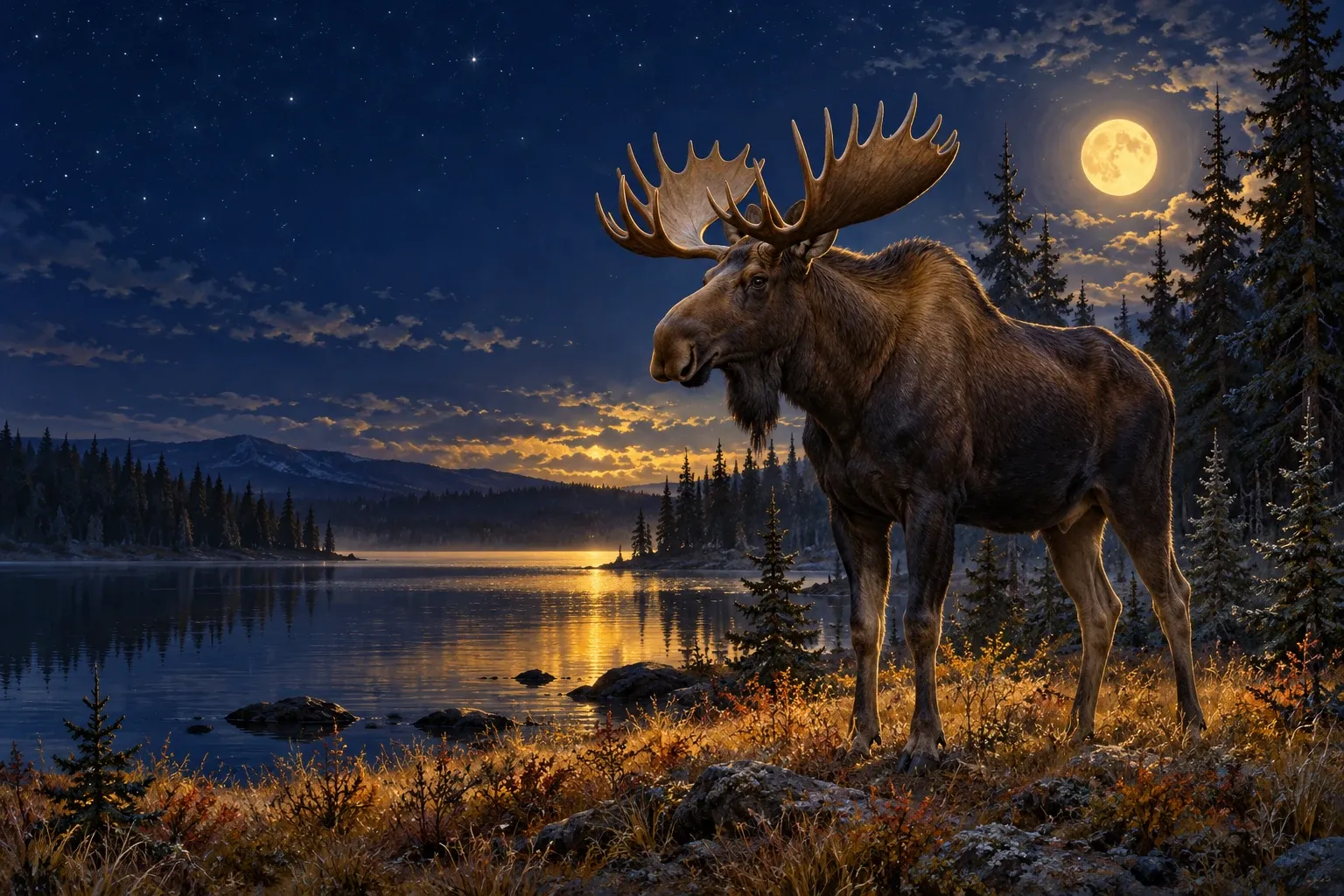
A moose can disappear into a stand of trees, though its shoulders rise above the brush. It wades into a pond, sinks beneath the surface, and comes up chewing fresh plants. Then it moves on through marsh or snow with a sure step that belies its size. Moose carries a particular kind of strength: broad and visible when the moment calls for it, quiet and self-contained the rest of the time. Its teaching is to trust your senses, protect what matters, and keep your own pace.
Moose stands its ground with care
A cow moose protects her calf fiercely. A bull’s wide antlers help defend him and contend with rivals during mating season. Moose has no need to make every encounter a fight; its power is already plain in its size, its alertness, and the ground it can cross. When Moose appears in a difficult season, it speaks to courage with judgment. Take up the space your work deserves, and notice when your strength is making others feel unsafe. Stand firm when something precious needs protecting, and let a needless contest pass.
The calf eventually leaves its mother and makes its own way. That separation belongs to the moose’s story as much as the mother’s vigilance does: care can give a young one the strength to live independently. Moose asks you to take pride in what you have done, share your happiness without turning it into a contest, and let those you love grow into their own lives. If you are carrying a turbulent stretch, remember the animal that keeps moving through deep snow and wet ground. Endurance is the steady work of finding the next place to stand.
A solitary path with keen senses
Outside mating season, moose are often solitary. They range through woods, marshes, and lakeshores, feeding on leaves, twigs, and water plants. Their long legs make difficult terrain passable, while their hearing and sense of smell help them attend to what is nearby. Moose kinship has room for solitude, observation, and a nature that can seem awkward one moment and graceful the next. You do not have to change your whole nature to meet a new stretch of ground; find the way your own strengths carry you across it.
The moose’s senses offer a plain lesson in discernment. If something feels off, pause long enough to listen and look again. Its eyes can move independently, keeping watch across different parts of its surroundings. Picture that wide attention when you need to see a situation from another angle or notice what you missed while concentrating on one thing. The animal does not have to rush toward an answer; its attention is already at work.
The antlers of a bull moose grow and are shed in a yearly cycle. They are a striking sign of display and defense, but their cycle also carries a gentler image: what served in one season can fall away as another begins. Moose lends a calm, watchful strength when you need a fresh perspective, and the privacy to gather your thoughts when other people’s noise grows loud. Take a quiet interval and return to your path when you can see it clearly again.
What a moose does in a dream
A moose watching from the trees can bring the feeling of a situation that deserves your full attention. Its great size makes it difficult to overlook, while its stillness gives the image a quality of watchfulness. A moose that seems to be listening points toward listening more carefully yourself, especially to someone whose words you have been too quick to dismiss.
A moose running away can reflect a moment when you feel you have backed away from a difficult encounter. The dream does not pass judgment on you; it puts the image of retreat in front of you to consider. A wounded moose can suggest that a strong or protective presence is under strain. Look at what has happened to the animal in the dream: the action, more than its impressive antlers or size alone, shapes what the image may mean.
Moose in distinct northern traditions
Cree and Ojibwe traditions connect Moose with endurance and survival. The Cree also count Moose among their clan animals, and the Chippewa and Menominee have Moose Clans. These are distinct communities with their own traditions; the moose does not carry one shared teaching for all Native peoples. Its strength in the northern landscape gives endurance a bodily image: finding food, crossing difficult ground, and holding on through winter.
A Potawatomi story tells of a woman seeking a mate among the forest animals so that she might have companionship. She considered many creatures and found none suited to her until she met a moose. She saw in him the qualities she hoped for, asked him to marry her, and he agreed. Humans carry some Moose within them. The story gives the animal a place in the beginning of human life, joining its formidable presence with companionship and kinship.
Athapaskan hunters shared a close bond with Raven and Moose. They spoke to Raven and asked for help on the hunt; when Moose appeared, they received the animal as a sacred gift. A moose’s arrival carries gratitude as well as importance. The animal offers sustenance, and its presence asks the hunter to recognize what has been given.
Moose ends its day as it often begins: attentive to the ground beneath its feet, with water and shelter close by. Picture it lifting its head from the pond, leaves hanging from its muzzle, then stepping quietly into the trees. Its great strength does not hurry to prove itself. It knows what it can carry, what it must guard, and when it is time to move on.